

- SOLUTIONS
-
- Countries
- Stories
- About Us
-
-
- HOW CAN WE HELP?
- Find out how we can assist you to achieve higher growth through services that are tailored to your company needs.
-
- GLOBAL INSIGHTS
Operating with a PEO in the Netherlands doesn’t always require going through all the challenges typically associated with hiring or managing overseas employees.
A PEO (Professional Employment Organization) is an alternative solution to incorporating an entity in a foreign market. A PEO can hire staff on your behalf and allow you to run your day-to-day activities without the red tape and regulatory concerns you may associate with expansion.
A PEO (Professional Employer Organization), like a global EOR (Employer of Record) provides crucial HR outsourcing services to companies seeking quick, safe, and cost-effective strategies for global mobility. INS Global’s PEO in the Netherlands allows companies to hire compliance assured workers in as little as 48h.
As a third-party organization that takes on the responsibilities of an employer, an Employer of Record (EOR) in Netherlands provides companies with a cost-effective and simple solution for the complications of overseas hiring and employee management. INS Global offers EOR services for companies looking to streamline the complexities of global mobility.
INS Global can be your local partner providing international PEO and EOR (Employer of Record) services to take care of HR concerns while you focus on driving growth in your business. With an active presence in more than 80 countries worldwide, we have the tools and experience to meet your requirements.
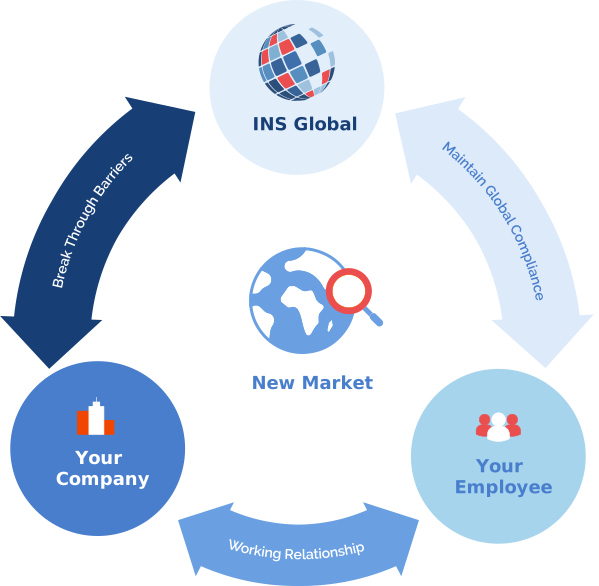
Working with a PEO gives you access to a fully functional pre-existing entity to hire and manage your employees. This means you avoid the red-tape and complexities associated with company incorporation or other setup methods.
A PEO allows you to begin operations in the Netherlands in a matter of days. Faster market entry means less wasted time and more growth opportunities.
A PEO services provider will take care of the HR and regulatory tasks associated with entering a new market. While they take care of the day-to-day, you can focus on what matters to your success.
PEOs provide you with HR tools and systems that might otherwise be inaccessible or not cost-effective. These resources can give you the advantage you need to succeed in a competitive market.
A Netherlands PEO services provider works with you to offer solutions that meet your needs, whatever they are. Furthermore, you can increase or scale back your plan to meet your company’s changing situation.
The administrative requirements for incorporating a new or separate legal entity in the Netherlands are numerous and complex. Well-developed regulatory systems mean companies wishing to begin in the market need to be aware of how to remain compliant with labor standards at all times.
The processes involved in setting up a company can mean thousands of euros in fees or overheads and months of work. However, working with a local PEO or EOR (Employer of Record) services provider can prevent these complications. A PEO allows you and your employees to get to work in a fraction of the time and cost.
The Advantage in Figures
| PEO/EOR | Company Incorporation | ||
|---|---|---|---|
|
|
|||
|
Price |
80% Less Expensive |
|
|
|
Market Entry |
2-5 Days |
6 Months |
|
|
Employee Turnover |
Decrease by 14% |
|
|
|
Recommendation |
98% of the Current PEO Clients |
|
|
|
Administrative Fees |
Saves an Average of $450 |
|
|
|
Costly Payroll and Compliance Fines |
Help Avoid |
|
|
|
Company Growth Rate |
7 - 9% |
|
|
|
ROI |
27% |
|
|
|
Closed During Pandemic |
-58% |
|
|
|
|
|
||
Manuel Ramos
TERAO ASIA
Managing Director
We think INS Global is a good solution about starting business in new and complex markets. Understanding the market doesn’t mean you need to set up a company immediately.
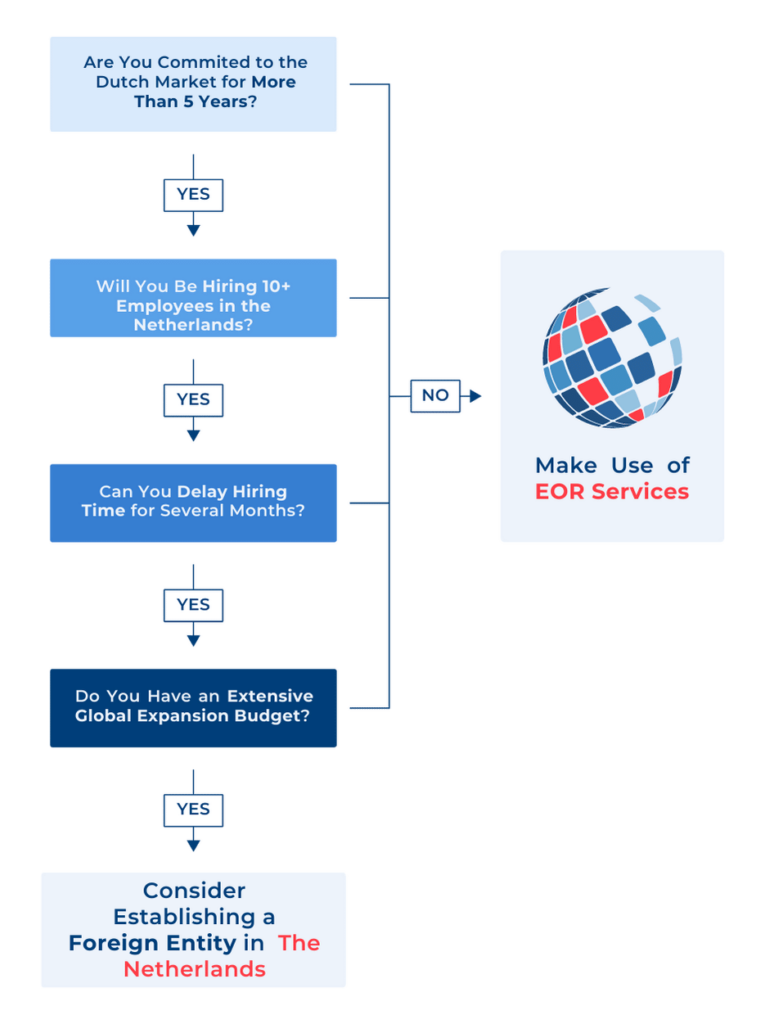
INS Global offers a solution following these 4 simple steps:
INS Global can provide a range of HR services outsourcing solutions to meet your needs and keep your operations running efficiently in the future. These can include payroll services outsourcing, international RPO (Recruitment Process Outsourcing), or contractor management.
While the two terms are used to denote nominally similar services, the ways these services are provided differ in how they relate to the client and their employees.
INS Global offers both PEO and EOR services in the Netherlands, ensuring that you have access to whichever option best meets your demands.
The Netherlands has a relatively high rate of income tax on gross pay, which must be managed by the employer on behalf of their employees. Tax rates go as high as 52%. In addition, social security contributions are made by the employee (deducted from their salary by the employer) and the employer.
According to labor law in the Netherlands, an employee cannot be given a fixed period contract more than 3 times in a row.
If either the duration of the contracts or the number of fixed contracts concluded exceeds the statutory limit of 2 years, the contract of employment automatically becomes an indefinite contract
If a contract is for a period of under 2 years, the probation period cannot be longer than 1 month.
The maximum probation period in the Netherlands is set at 2 months, and if an employee is contracted for a period of fewer than 6 months, an employer cannot require any probation period.
The standard average working hours for a full-time employee in the Netherlands is 38 hours a week. However, many companies have their employees working between 36 – 40 hours a week as standard.
The maximum working hours allowed per day are 12 hours per shift or 60 hours per week. However, this limit is only available for brief periods, and employees may not work more than 55 hours a week for over 4 weeks.
Employees in the Netherlands are eligible for annual leave equivalent to 4 times their standard weekly working amount. For an employee working 5 full days per week, this means they would be entitled to 20 days of annual paid leave.
While the Netherlands observes 11 days of public holidays per year, employers are not obliged to give employees time off on these days. Mandatory leave on these days should be agreed upon in your contract with your employee or may be specified in the collective labor agreement for your sector.
Employees in the Netherlands may be eligible for up to 2 years of paid sick leave with proof of inability to work. The pay received during this time is a minimum of 70% standard salary. This is paid by the employer, and after the 2 year period, payments cease, with the employee being transferred to long-term social insurance benefits.
Maternity leave in the Netherlands is mandatory for 4 weeks before the expected due date and 12 weeks after the birth of a child.
This leave is paid at 100% standard salary up to a maximum threshold paid by the government. However, it is common practice for employers to make up the extra in the event that this maximum amount does not provide 100% of an employee’s salary.
Paternity leave is 1 week fully paid, and 5 weeks paid at 70% standard salary.
As of 2022, parents in the Netherlands can also apply for 9 weeks of partially paid parental leave during the first year of a child’s life, and unpaid leave during the first 8 years of their life.
Earned income in the Netherlands is taxed in 3 separate ways, called “Boxes”
Box 1:
Box 2:
Box 3:
Employers are expected to arrange social security contributions for employees towards health insurance, unemployment insurance, and national insurance. These amounts to an employer’s contributions of around 18% of their employee’s standard salary (some of these costs having been lowered in 2021).
No, it is necessary to use a local entity abroad to comply with each country labor law.
Foreign companies can either set up a local entity in each country or use the services a local PEO (Professional Employment Organization) to hire the staff on-site directly.
The employer of record is the legal entity liable for the staff employed in a specific country. In practice, a foreign company can either open a subsidiary to become the employer of record of its abroad employees or use a PEO to act as the employer of record.
In general, 1-month is necessary to have an employee based out abroad using an existing PEO as the employe of record. When incorporating a new subsidiary to be the employer of record, the delay varies from 4-12 months.
For a single monthly cost based on the salaries of your co-employed employees, a top-notch PEO in the Netherlands acts as a services provider to handle all relevant HR functions, including payroll, contract administration, and guaranteed tax compliance.
Yes, EORs provide you with a secure, simple, and legitimate means to hire or transfer workers in The Netherlands. This employment solution works either permanently or while you take the time to establish your own corporate structure.
In addition to paying new hires’ salaries, indirect expenses like social insurance contributions and any bonuses or incentives must also be covered by the employer. Signing bonuses are uncommon but may make you a particularly attractive employer.
Yes, an EOR can employ workers on your behalf both in every region of the country or abroad.
Changes to an employee’s contract can only be made after consultation with the employee in question, however, in some cases, changes can be made without the employee‘s express consent. These cases include: when a fixed-term contract is about to end, if the contract includes a provision for unilateral changes, and where changes are considered fair or could potentially benefit the employee.
Employers in The Netherlands are responsible for taking care of all payroll taxes, benefits management, and workplace safety. This includes ensuring that all the employee’s rights are met, including receiving a salary that meets minimum wage requirements and being eligible for the minimum amount of annual and medical leave.
Yes, employers are expected to withhold salary amounts for taxes and payroll on behalf of the employee, as well as pay around 12.86% of the employee’s salary in employer contributions.
Generally regarded as one of the most comprehensive social insurance systems worldwide, resident employees benefit from multiple forms of social security including a pension, sick pay, and child support. Multiple allowances can be applied for on a worker’s behalf to improve their quality of life such as a remote work allowance, travel allowance, and equipment reimbursements.
All employers are obliged to join the health insurance system when they begin to hire workers. By deducting payroll amounts for social insurance contributions, employees are then eligible for a highly comprehensive system of healthcare. Employees pay a mandatory excess amount for healthcare, with the rest then being covered by insurance.
There may be minimal or maximum numbers of employees you may hire using certain PEO businesses’ services. However, INS Global allows you to manage as many or as few employees as your expansion strategy calls for.
Should a situation require severance pay, this is typically a minimum of 1/3 of an employee’s monthly wage per year of service with the company (up to a maximum of the equivalent of the employee’s average salary for a year).
A separate physical office is not necessary for employing remote workers in the Netherlands, but even those working at home can require employers to help provide a safe “ergonomic” workspace. This may require the employer to provide all the equipment necessary for a remote worker to do their job.
The Netherlands Labor Authority (Nederlandse Arbeidsinspectie) governs Dutch working conditions and may carry out inspections of the workplace and work practices in a company.
Our recruiting specialists are familiar with regional standards and best practices with professional access to industry-specific networks and resources both online and offline.
In The Netherlands, a professional staffing company or recruitment agency will normally charge a recruiting fee calculated as a portion of the new employee’s monthly gross compensation. INS Global can offer these services and fully integrate them with our PEO solution to offer a complete employment outsourcing package.
The Netherlands recognizes 8 annual public holidays, however, these are not required to be paid unless an employee is required to work on them.
With a robust system of workers’ rights, employees don’t have to worry about many of the same issues as if they would be working in less developed countries. However, small infractions may cause significant fines and fees for both employees and employers, and both should be careful to maintain constant legal compliance.
Yes, INS Global can offer recruitment, PEO, and EOR services for both Dutch citizens and foreign residents.
Level 39, Marina Bay
Financial Centre Tower 2,
10 Marina Boulevard
Singapore 018983